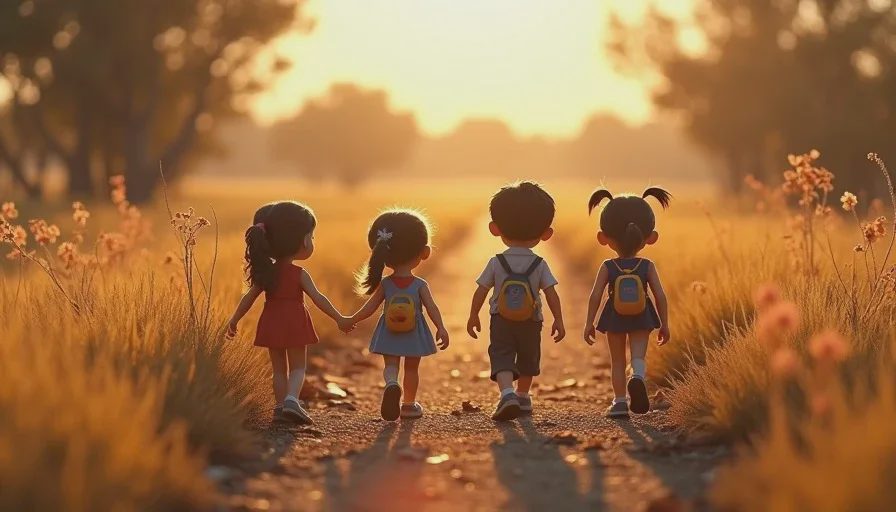
Most co-op games are designed around shared violence or shared efficiency. You shoot the same enemies, carry the same objectives, optimize the same loops. The conversation that happens while you play is usually secondary — coordination, callouts, the occasional joke when something goes wrong.
Big Walk treats the conversation as the main system.
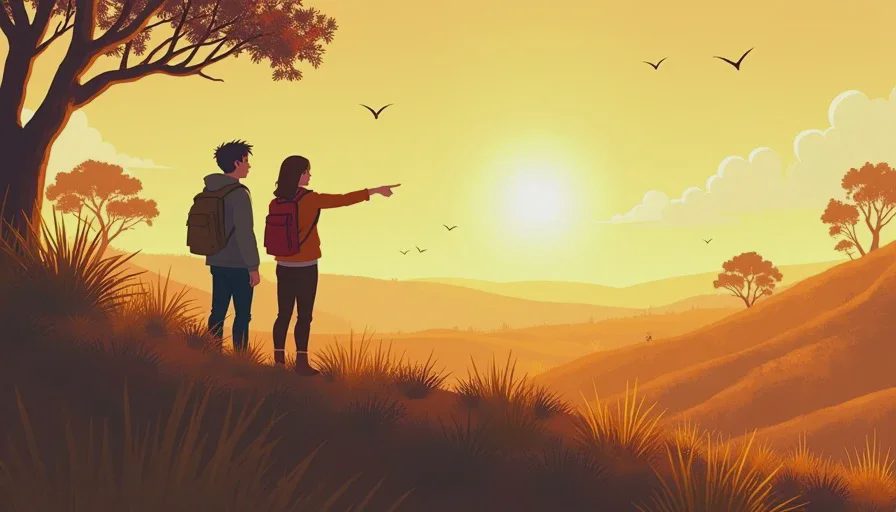
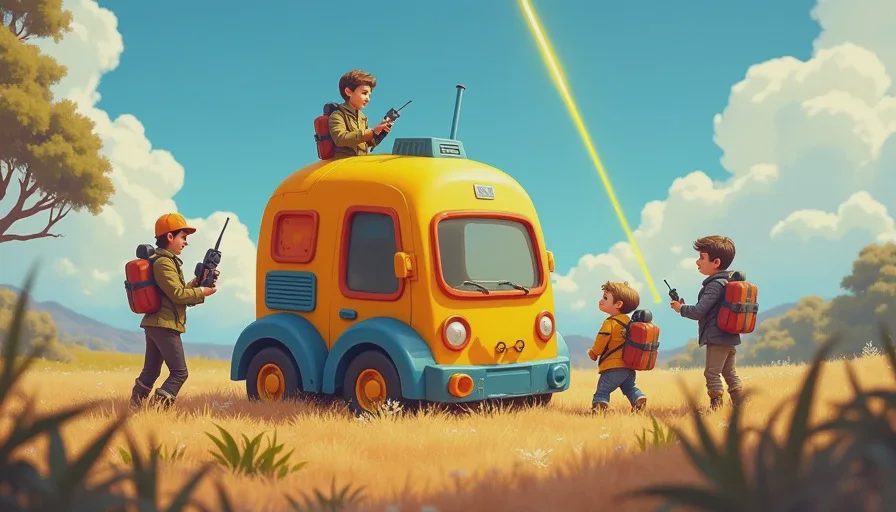
Released on August 4, 2026 by House House (the Melbourne studio behind Untitled Goose Game) and published by Panic, it is a cooperative adventure for two to twelve players. You explore a wide, hand-crafted open world inspired by Wilsons Promontory National Park. There are no enemies to kill. There is no loot treadmill. The central activity is moving through the landscape together, solving environmental puzzles that require communication, and using an assortment of tools — walkie-talkies, laser pointers, cowbells, whiteboards, flares, megaphones — when ordinary speech is not enough or not possible.
Proximity voice chat is the core mechanic. Voices fade with distance, echo in certain spaces, and crackle when you switch to radios. If someone wanders off, you literally lose them in the audio mix. The design forces you to stay aware of where your friends are, not because a UI marker told you to, but because the soundscape itself becomes incomplete when they are gone.
How the game actually plays
You start with almost no instruction. The world is large, beautiful, and mostly empty of traditional game signposting. Bright, oversized, toy-like structures dot the landscape. Inside most of them are puzzles that cannot be solved alone. Some require simultaneous actions at different locations. Some require one person to describe what they see while another operates a mechanism. Some punish you for talking too loudly or at the wrong time. The tools you unlock expand the ways you can signal, plan, or simply mess with each other.
The tone is gentle and slightly absurd. There is room for chaos — twelve people with cowbells and laser pointers can turn a quiet ridge into pure noise — but the game never demands that chaos. Two people playing carefully can have a completely different, almost meditative experience. The flexible player count is not a marketing checkbox; it genuinely changes the texture of the evening.
Progress is measured in discoveries and in the quiet satisfaction of a puzzle finally clicking because someone explained something clearly, or because someone stayed patient while the rest of the group figured it out. There is an ending. The game is designed to be played through rather than lived in forever. That finite quality is part of its strength.
Why it feels different
I have played a lot of co-op games that claim to be about friendship. Most of them are actually about shared competence. Big Walk is one of the few that makes the quality of your communication the primary skill check. You cannot out-gear a communication failure. You cannot skip the talking. The game keeps putting you in situations where the only solution is to be present with the people you are playing with.
That sounds simple. It is surprisingly rare.
The world itself supports the feeling. The bushland is spacious without being empty. The scale lets groups naturally split and re-form. The lack of constant combat or resource pressure means the conversation can wander. You end up talking about the landscape, about old trips, about nothing in particular, while still moving toward the next structure. The game creates space for the kind of low-stakes, high-presence social time that most multiplayer design actively works against.
The ending, when it arrives, lands with a weight that feels earned precisely because the preceding hours were spent simply being with people in a shared place. Several reviews have described it as bittersweet. I understand why. It is not a twist. It is a quiet recognition of what the walk has been.
The personal part
I played most of my time in Big Walk with two close friends who live in different cities. We are all busy. Coordinating a full evening is harder than it used to be. The game gave us a reason to protect a few nights and then rewarded that protection by making the time feel like time spent together rather than time spent executing a plan.
That is a higher bar than most games clear. A lot of multiplayer experiences are fun while they last and leave almost no residue. Big Walk left a residue. After we finished I found myself missing the specific sound of their voices fading in and out as we moved across ridges. I missed the dumb arguments about which way was north. I missed the moment when a puzzle finally resolved and everyone went quiet for a second before the laughter started.
In a year full of large, high-production, systems-heavy games, the one that made me most aware of the people I care about was a walking simulator with cowbells and proximity chat.
Who should play it
If your friends only enjoy games that involve shooting or competing, this will not convert them. If you need constant mechanical complexity or a strong single-player backbone, look elsewhere. Big Walk is at its best with people you already like and with whom you are willing to be a little silly and a little patient.
If you have been looking for a co-op game that treats presence as the point rather than as a side effect, this is one of the clearest examples in years. It is not perfect — large groups can become chaotic in ways that dilute the quieter pleasures, and the walking itself is deliberately unheroic — but the core idea is executed with unusual confidence.
House House spent six years on this. You can feel the time in the restraint. They did not try to make the biggest co-op game. They tried to make a good place to walk with the people you already want to talk to.
That turns out to be rarer, and more valuable, than another competent multiplayer sandbox.
I finished it and immediately started thinking about who I wanted to walk with next. That is the highest recommendation I have.
— Alex





No notes yet — write the first.