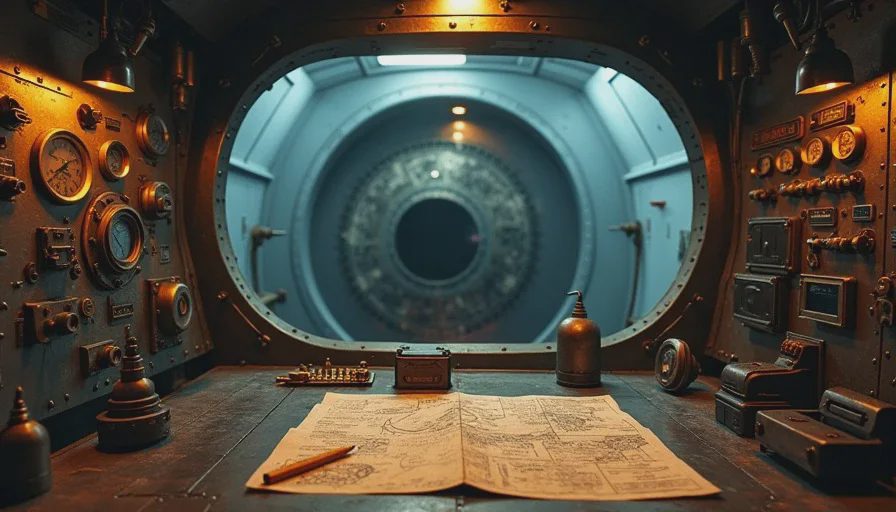
I loaded the demo during Next Fest mostly out of curiosity. The title alone felt like a dare. Heavy Turret Simulator. Two developers. Dieselpunk. Alternate-history Spain. I expected a novelty that would amuse me for twenty minutes and then sit in the library forever.
Instead I stayed up until three in the morning drawing lines on a map and arguing with a ballistic calculator.
Iron Nest released fully on August 6. Within days it was sitting at Overwhelmingly Positive with thousands of reviews clustered around 97–98 percent. The number keeps climbing. People are not being polite. They are genuinely attached to this strange, deliberate machine.
What you actually do
You are the sole operator of the Iron Nest, a roughly 5,000-ton mobile turret-landship fighting for a fictional monarchy in an alternate 1920s Castile where the First World War never happened. High Command sends orders through a teleprinter. Spotters send coordinates and fragmentary reports. You never see the battlefield with your own eyes.
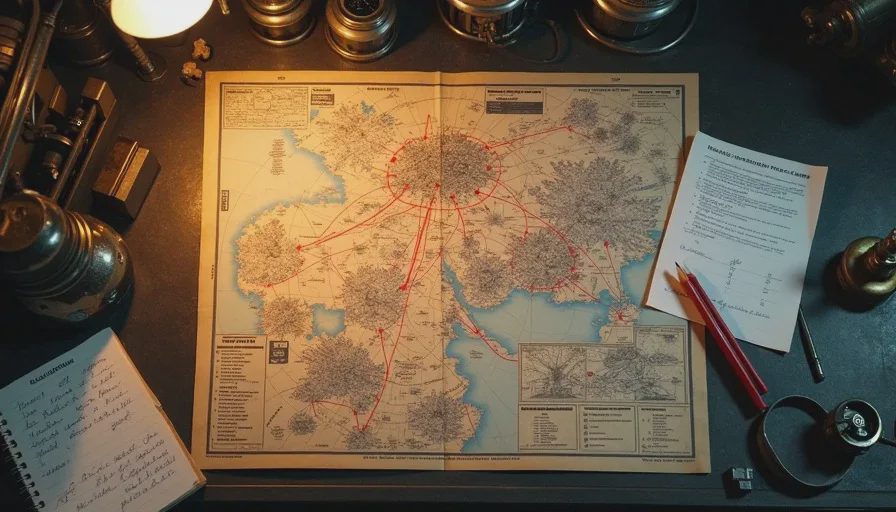
Your job is to turn those scraps into accurate fire.
You measure bearings and distances on a physical tactical map. You feed the numbers into a ballistic calculator that spits out elevation and charge data. You order the correct shell from a growing arsenal of around thirty types—high-explosive, armor-piercing, smoke, chemical, and stranger options. You load the round and the powder charges by hand. You crank the massive hydraulics to lay the guns. Then you fire and wait for the results to come back through the same imperfect channels that gave you the target in the first place.
Misses are your fault. Hits feel earned in a way most games never manage. The loop is slow on purpose. The satisfaction comes from competence, not spectacle.
There is a campaign that moves across fifteen regions, procedural mission elements that keep the problems fresh, challenge modes, medals, newspaper reports that quietly track the human cost of your decisions, and even a customizable cat that lives in the cabin with you. The sound design is excellent—every lever, every shell casing, every distant impact has weight. The cabin itself becomes a character.
Why the numbers make sense
Most games that try to be “realistic” simulators either drown you in menus or sand off the edges until the fantasy collapses. Iron Nest keeps the friction and makes it the point. The first hour feels awkward. You will misread a coordinate. You will load the wrong charge. You will watch a carefully prepared solution land short because you forgot to account for something obvious in hindsight.
Then the process clicks. The notepad (the in-game one is genuinely one of the best interface tools I’ve used in years) becomes second nature. You start anticipating the kinds of problems High Command will throw at you. Supporting an infantry push with smoke. Timing a shot on a moving train using its schedule and your own watch. Counter-battery work against enemy guns that are also trying to kill you. The game never stops being methodical, but the method becomes fluent.
That fluency is rare. It is also why the reception has been so strong. Players who bounce off pure action games or pure management sims are finding something in the middle that respects their attention. The two-person team—Nick and Dominik—clearly built the game they wanted to play. You can feel the obsession in every dial and every newspaper clipping.
The moral texture helps too. You are not a glamorous hero. You are a function inside a very large weapon. The newspapers that arrive after missions do not always celebrate your accuracy. Sometimes they just list the consequences. The game never lectures, but it also never lets you pretend the shells land in a vacuum.
Who this is actually for
If you need constant forward momentum, skip it. If you hate reading coordinates or doing simple math under mild time pressure, skip it. If you want to see the explosions from a dramatic third-person camera, this is not that game.
If the idea of sitting inside a giant dieselpunk machine and turning imperfect information into precise violence sounds strangely compelling, the demo is still up and the full game is cheap. I bought it after the demo without hesitation. It has already earned multiple evenings, and I keep thinking about the next set of coordinates while I’m supposed to be doing other things.
There is a particular pleasure in games that trust you to be competent instead of constantly rescuing you from your own mistakes. Iron Nest does that. It also happens to be one of the most distinctive things released this year—a small team swinging hard at a very specific fantasy and connecting.
I did not expect to care this much about artillery procedure. Now I do. That is the highest compliment I can give it.
This one earned my evening. More than once.
— Alex





No notes yet — write the first.